

Your page ranks #1 on Google. Google’s AI Overview cites your competitor instead. You just lost a $25,000 deal you’ll never know about. This scenario plays out thousands of times daily as AI-generated answers intercept buyer journeys before traditional search results ever load. AI Overviews now appear on roughly 48% of tracked queries – up 58% year-over-year (BrightEdge, February 2026) – and the coverage is accelerating. Yet most marketing teams still can’t answer a basic question: What is each SERP position actually worth in AI visibility, and how does that translate to revenue?
This report maps the complete chain from SERP position to AI citation probability to conversion premium to pipeline impact, using data from 30+ studies published between 2025 and 2026. By the end, you’ll know the exact citation probability at each SERP position, understand how that probability varies by industry and platform, and have a complete audit framework – including formulas – to calculate your own AI citation ROI.
TL;DR Summary
- Citation probability by position: SERP position #1 earns a 33.07% AI Overview citation probability; position #10 drops to 13.04% – a 60% decline (GetPassionFruit, 2025).
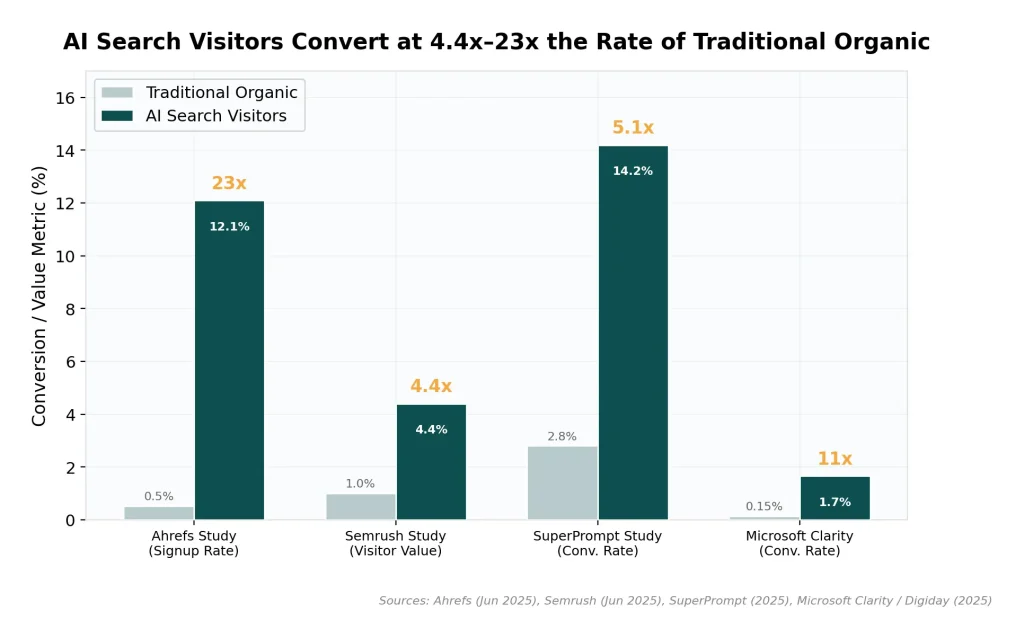
- Conversion premium: AI-referred visitors convert at 23x the rate of traditional organic search visitors – Ahrefs data shows 0.5% of traffic drove 12.1% of signups (Ahrefs, June 2025).
- CTR boost from citation: Brands cited in AI Overviews earn 35% higher organic CTR and 91% higher paid CTR compared to uncited brands on the same queries (Seer Interactive, November 2025).
- The counter-point: AI Overview citations perform at roughly Position 6 click levels – high visibility, but far fewer clicks than top blue links (Search Engine Land, September 2025).
- Industry variance: Finance sees the highest citation volatility; eCommerce is most stable. Health leads with 43.0% AI Overview share across all queries (Ahrefs, November 2025), but on informational keyword sets, verticals like Healthcare and B2B Tech reach far higher penetration (BrightEdge, 2025).
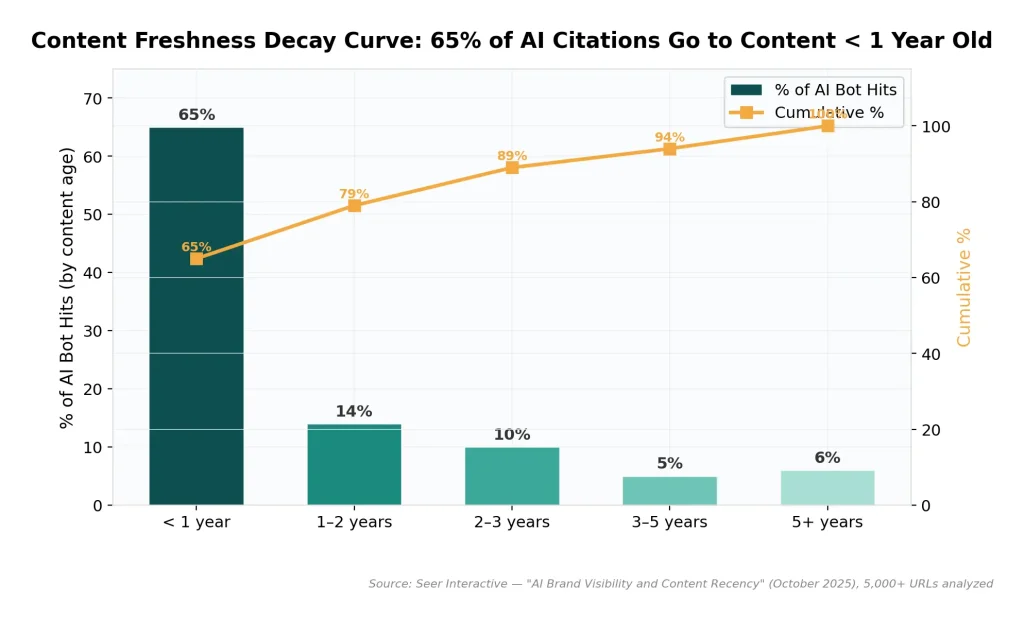
- Freshness drives citation: 65% of AI bot hits target content published in the past year; 89% hit content updated within three years (Seer Interactive, October 2025).
- The revenue gap is real: Organic CTR plummeted 61% for queries with AI Overviews present – from 1.76% to 0.61% (Seer Interactive, September 2025). The companies building citation tracking infrastructure now will capture the compounding advantage.
Quick Summary: SERP position still determines AI citation probability, but the relationship is non-linear, industry-dependent, and requires entirely new attribution models to translate visibility into measurable revenue.
Executive Summary: The Position-Revenue Matrix
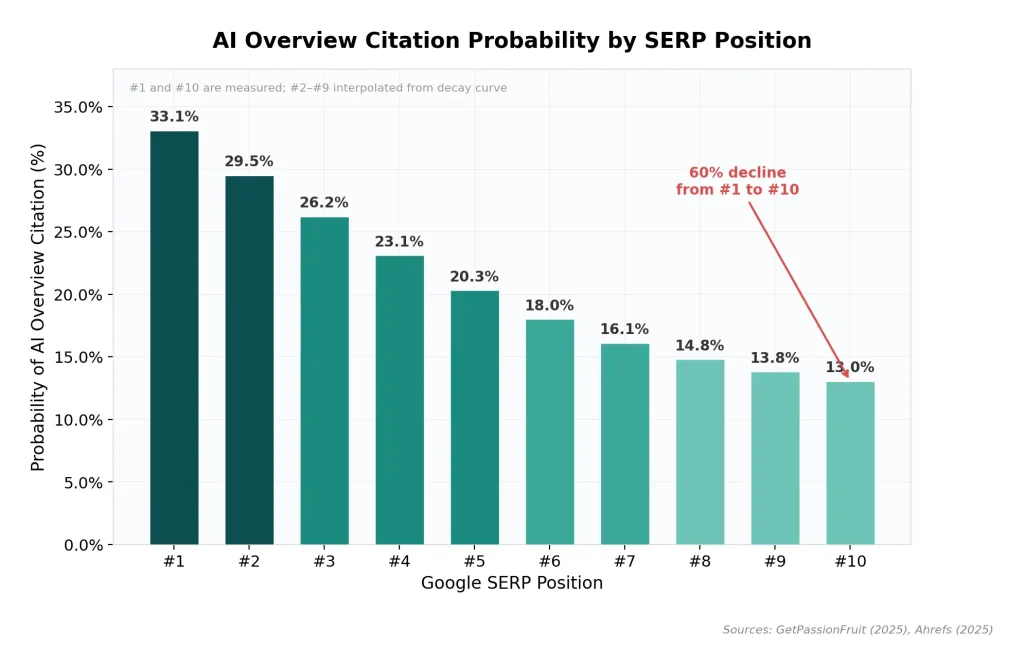
The data tells a clear story: traditional SERP rankings remain the foundation of AI visibility, but the value of each position has fundamentally changed. 76.1% of URLs cited in AI Overviews also rank in Google’s top 10 organic results (Ahrefs, 2025), confirming that ranking authority still matters. However, the revenue pathway now runs through a new intermediary – the AI citation layer – where position #1 earns a 33.07% citation probability while position #10 drops to 13.04% (GetPassionFruit, 2025).
What makes this actionable is the conversion premium. Ahrefs’ own data reveals that AI search visitors convert at 23x the rate of traditional organic visitors: just 0.5% of total traffic from AI platforms generated 12.1% of signups in a 30-day period (Ahrefs, June 2025). Semrush data corroborates this pattern, showing AI search visitors worth 4.4x traditional organic visitors (Semrush, June 2025). When you combine citation probability with the conversion premium, the revenue gap between position #1 and position #10 in an AI-first SERP becomes dramatic.
Meanwhile, the CTR environment is collapsing around uncited brands. Seer Interactive’s study of 3,119 informational queries across 42 organizations found organic CTR plummeted 61% (from 1.76% to 0.61%) for queries where AI Overviews appear (Seer Interactive, September 2025). But brands that are cited in those AI Overviews earn 35% higher organic CTR and 91% higher paid CTR compared to uncited brands on the same queries. Citation isn’t optional – it’s the new competitive moat.
| SERP Position | AI Overview Citation Probability | CTR Impact (Cited vs. Uncited) | Conversion Premium (AI vs. Organic) | Revenue Implication |
| #1 | 33.07% | +35% organic CTR, +91% paid CTR | 23x (Ahrefs) / 4.4x (Semrush) | Highest revenue capture; citation compounds brand authority |
| #2–3 | ~25–30% (estimated from top-10 decay) | Same CTR boost when cited | Same conversion premium applies | Strong position; prioritize citation optimization |
| #4–5 | ~18–22% (estimated) | CTR drops steeply by citation position 4–5 | Conversion premium holds but volume falls | Monitor weekly; risk of losing to more authoritative competitors |
| #6–10 | 13.04–17% | Marginal CTR gain from citation | Conversion premium applies to fewer visitors | Investment in climbing SERP or building alternative authority signals |
| #11+ | Citation probability drops ~4x vs. top 10 | Minimal; negligible citation occurrence | N/A at scale | Traditional SEO investment required before AI optimization |
👉 Audit tip: Check your top 20 target keywords right now. For each, note your current SERP position and whether you appear in the AI Overview. The gap between these two data points is your Revenue Visibility Gap – the revenue you’re leaving on the table by ranking without being cited.
Every page can rank higher. We show you exactly how.
RankBloom, the page-by-page SEO audit tool, diagnoses every page on your site, then tells you what to fix, how to fix it, and where to start. Orphan pages, weak anchors, keyword gaps, spam signals – and more.
How SERP Position Maps to AI Citation Probability and Revenue
TL;DR:
- Position #1 earns 33.07% citation probability; #10 drops to 13.04% – a 60% decline
- 76.1% of AI Overview citations come from pages ranking in Google’s top 10
- AI search visitors convert 23x better than traditional organic visitors (Ahrefs, June 2025)
- Organic CTR drops 61% on queries with AI Overviews – from 1.76% to 0.61%
Position #1: The Citation Premium
If your page ranks first on Google, your probability of appearing in that query’s AI Overview jumps to 33.07%(GetPassionFruit, 2025). That’s nearly double your citation probability compared to merely being somewhere in the top 10. The mechanism is straightforward: AI models start with what Google’s ranking systems already surface as high-quality content. If Google’s crawler hasn’t identified your page as authoritative, AI models working from search indexes won’t find it either.
The decay is steep. Pages beyond position 10 see citation chances fall by approximately 4x compared to top-ranked content (GetPassionFruit, 2025). AI models don’t crawl the entire web for every query – they work from pre-filtered source sets built from existing search indexes. There is no shortcut past traditional ranking authority.
The Conversion Premium: Why AI Citations Carry Outsized Revenue Value
The citation matters because of what happens after it. Ahrefs published a landmark study in June 2025 showing that visitors arriving from AI search platforms generated 12.1% of all signups despite representing only 0.5% of traffic – a 23x higher conversion rate than traditional organic search visitors. These visitors go to 50% more pages per session and arrive pre-qualified: 80% of Ahrefs’ AI search traffic landed on homepage, product pages, and free tool pages rather than informational blog content.
Semrush data supports this pattern from a different angle, valuing AI search visitors at 4.4x traditional organic visitors (Semrush, June 2025). Microsoft Clarity data showed an even more granular picture: 1.66% conversion rate from LLM-referred traffic versus 0.15% from traditional search in one publisher study (Digiday, 2025).
Case Study: Ahrefs – From 0.5% Traffic to 12.1% Signups
Ahrefs’ own data provides the clearest named example of the position-revenue chain in action. As a domain with strong SERP authority across thousands of SEO-related queries, Ahrefs occupies top-10 positions for its core terms. That ranking authority translates directly into AI citation frequency – ChatGPT, Perplexity, and Google AI Overviews all reference Ahrefs’ research regularly.
The result: AI search traffic – just 0.5% of total visitors – produced 12.1% of signups over a 30-day measurement window. The visitors viewed 50% more pages per session and demonstrated lower bounce rates than traditional organic visitors. ChatGPT drove the majority of these referrals (Ahrefs, June 2025). The conversion advantage stems from intent: AI users arrive having already researched and compared options inside the AI interface. By the time they click through, they’re not browsing – they’re deciding. This fundamental shift in user behavior underscores how AI tools influence buyer journey, demanding new strategies for engaging pre-qualified prospects.
| Metric | Traditional Organic Search | AI Search Visitors | Difference |
| Share of total traffic | ~90%+ | 0.5% | – |
| Share of signups | ~87.9% | 12.1% | – |
| Relative conversion rate | 1x (baseline) | 23x | +2,200% |
| Pages per session | ~3.3 | ~5.0 | +50% |
| Primary landing pages | Blog content, tools | Homepage, product pages, free tools | Higher commercial intent |
🧠 Quick takeaway: Position #1 isn’t just about clicks anymore – it’s about being the first source of AI quotes. That citation carries a 23x conversion premium over traditional organic traffic. One AI citation to a high-intent page can outperform hundreds of traditional blue-link clicks.
AI Citation Revenue Benchmarks by Industry (2026 Data)
TL;DR:
- Health (43.0%) and Science (43.6%) lead AI Overview share across all queries (Ahrefs, November 2025); on informational keyword sets, penetration in Healthcare, Education, and B2B Tech climbs significantly higher (BrightEdge, 2025)
- Finance shows the highest citation volatility week-to-week
- Organic CTR declined 61% across informational queries with AI Overviews (Seer Interactive, 2025)
- AI Overviews grew 58% year-over-year, from ~31% to ~48% of tracked queries (BrightEdge, February 2026)
Healthcare, Education, B2B Tech: Near-Total AI Coverage
BrightEdge’s year-long tracking revealed that AI Overviews aren’t expanding uniformly. Healthcare, Education, B2B Tech, and Insurance now consistently show the highest AI Overview presence, with some nearing 90% penetration(BrightEdge, 2025). These sectors deal in authoritative, evergreen content where AI-generated summaries provide clear value to searchers.
The March 2025 core update accelerated this trend dramatically across specific verticals: entertainment saw a 528% increase in AI Overview presence, restaurants 387%, and travel 381% (BrightEdge, March 2025). For marketers in these verticals, the question is no longer whether AI Overviews will appear for their keywords – it’s whether their brand will be cited when they do.
Sector-Specific Ahrefs Data: Where AI Overviews Dominate (and Don’t)
Ahrefs’ analysis of 55.8 million AI Overviews across 590 million searches revealed sharp sector differences (Ahrefs, November 2025). Science leads with 43.6% AI Overview share, followed by Health at 43.0%, Pets & Animals at 36.8%, and People & Society at 35.3%. At the other end, Shopping triggers AI Overviews on only 3.2% of queries, Real Estate at 5.8%, and Sports at 14.8%.
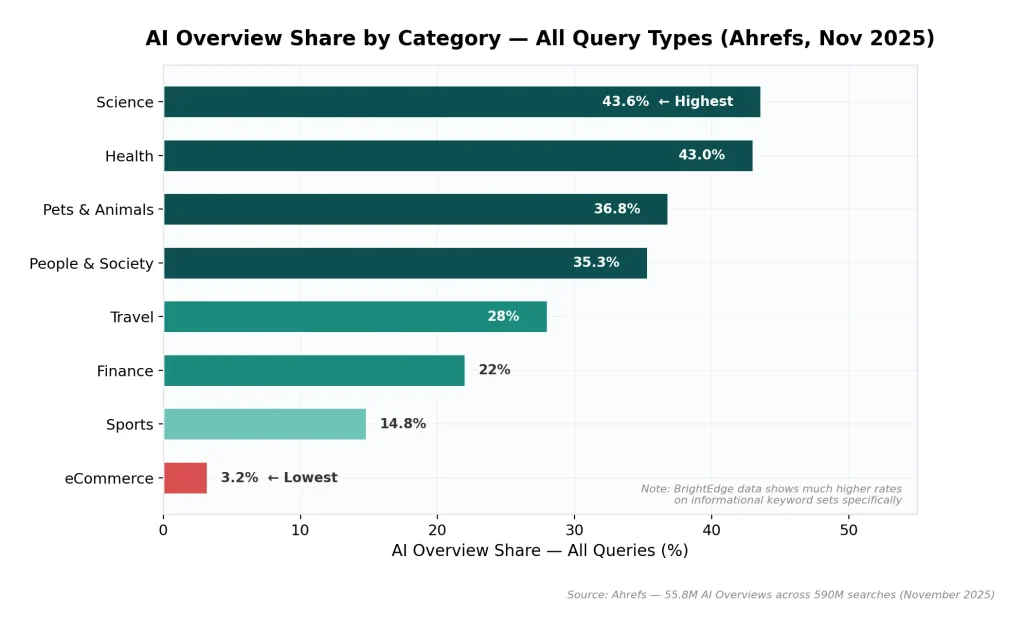
This segmentation matters for budget allocation. If you’re in a high-AIO-penetration vertical like Health or B2B Tech, citation optimization is urgent – your organic traffic is already being intercepted. If you’re in Shopping or Real Estate, traditional SEO still dominates, but expect AI Overview expansion into commercial queries as Google continues testing. For software brands navigating this shift, working with a specialized b2b tech seo agency aligns technical architecture with high-intent content to capture AI citations and safeguard pipeline.
| Industry Vertical | AIO Share — All Queries (Ahrefs) | AIO on Informational Keywords (BrightEdge) | Citation Volatility | Strategic Priority |
| Healthcare / Health | 43.0% | Very High (highest tier) | Moderate | Prioritize clinical authority signals; publish frequently |
| B2B Technology | High (top tier by BrightEdge) | Very High (highest tier) | Moderate-High | Build entity authority; target citation in buyer consideration queries |
| Finance / Insurance | Moderate-High | Very High (highest tier) | Highest(weekly fluctuations) | Monitor daily; content freshness critical due to regulatory changes |
| Education | High | Very High (highest tier) | Moderate | Institutional authority dominates citations |
| Science | 43.6% (highest by Ahrefs) | — | Moderate | Research-depth and data density drive citation |
| Travel | Growing (381% AIO growth in Mar 2025) | Growing | Moderate | Update seasonal content aggressively; recency bias is strong |
Case Study: HubSpot – The Traffic Collapse That Proved Citation Matters
HubSpot’s widely reported traffic decline in 2025 illustrates what happens when a dominant informational content strategy meets AI Overviews without citation optimization. Industry reporting documented an approximately 80% traffic drop across HubSpot’s blog properties as AI Overviews increasingly answered the high-funnel informational queries – “what is inbound marketing,” “how to create a CRM” – that had driven HubSpot’s organic growth for over a decade (Search Engine Land, Seer Interactive, 2025).
The lesson isn’t that content marketing is dead. It’s that informational content now serves a different function: it builds the authority signals that earn AI citations, which then drive higher-intent traffic to product and conversion pages. HubSpot’s volume of clicks declined, but the strategic question became whether citation presence could offset the loss with higher-converting visitors. To answer this strategic question, a recent report on GEO traffic optimization reveals the data-backed tactics marketers are using to drive higher-converting AI-referred sessions.
✅ Practical benchmark: If you’re in Healthcare or B2B Tech, AI Overviews already appear on 43%+ of all queries in your category – and the rate is far higher on informational keywords. Citation optimization is not optional. If you’re in Finance, expect the highest citation volatility of any vertical – monitor weekly at minimum. If you’re in eCommerce (3.2% AIO trigger rate), focus on product-level schema now to prepare for the next wave of expansion into commercial queries.
Cross-Platform AI Citation Architecture: Where Revenue Differs
TL;DR:
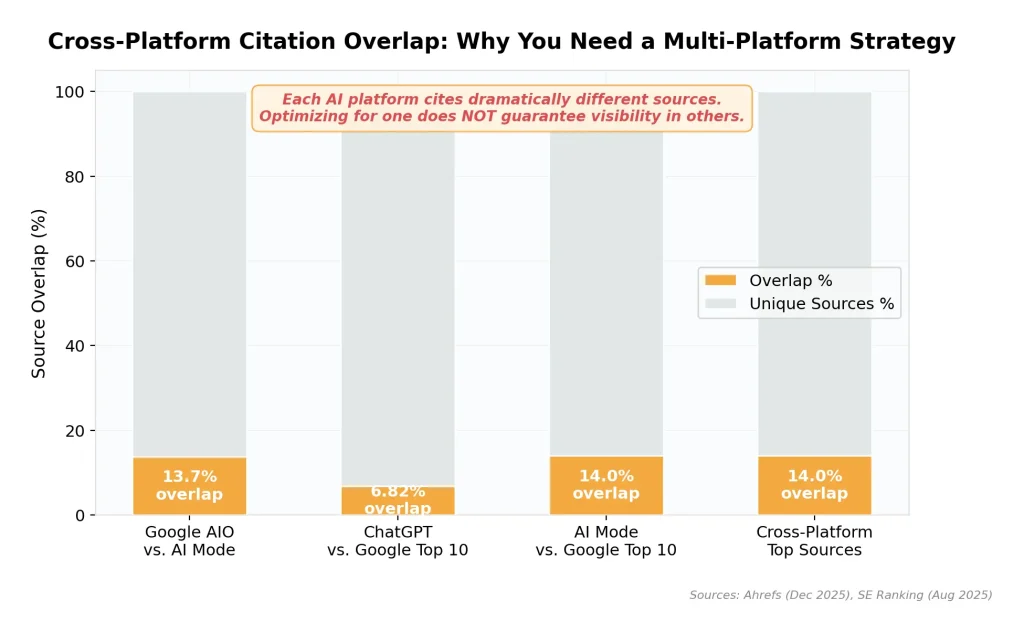
- AI Overviews and AI Mode show only 13.7% URL overlap – different systems cite different sources (Ahrefs, December 2025)
- Only 6.82% of ChatGPT results overlap with Google’s top 10 (Ahrefs, 2025)
- 28.3% of ChatGPT’s most-cited pages have zero organic visibility in Google
- Each platform has distinct source preferences and recency biases
The Platform Fragmentation Problem
Marketers treating “AI” as monolithic are misallocating resources. Ahrefs’ December 2025 analysis found only 13.7% URL overlap between AI Overviews and AI Mode – despite both being Google products (Ahrefs, December 2025). SE Ranking’s August 2025 data confirmed this divergence: just 10.7% of URLs and 16% of domains overlap between AI Overviews and AI Mode (SE Ranking, August 2025). Because these platforms prioritize different content signals, relying on a single ranking strategy leaves significant visibility gaps – deploying answer engine optimization services allows brands to map specific query intent to the unique citation requirements of each generative model.
ChatGPT operates from an entirely different source ecosystem. Only 6.82% of ChatGPT results overlap with Google’s top 10 organic results (Ahrefs, 2025). More striking: 28.3% of ChatGPT’s most-cited pages have zero organic visibility in Google search (Ahrefs, October 2025). This means a page that ranks nowhere on Google can still be the primary source ChatGPT references for a given topic.
Platform-by-Platform Citation Architecture
Each AI platform applies different retrieval logic, source preferences, and freshness biases. Understanding these differences determines where your citation optimization investment will generate the most pipeline value.
| Dimension | Google AI Overviews | Google AI Mode | ChatGPT | Perplexity |
| Primary source index | Google’s organic search index | Google’s index (different filtering) | Bing Search API (92% of the time) | Own web retrieval layer |
| Overlap with Google Top 10 | 76.1% of citations from top 10 | Only 14% from top 10 | Only 6.82% overlap | Moderate; favors news, research |
| Freshness bias | Strong – 85% of citations < 2 years old | High volatility; 9.2% self-overlap on repeated tests | Strongest recency lean, but cites some older Wikipedia pages | 50% of citations from 2025 alone |
| Citation volume per response | ~13.3 sources on average | ~12.6 links on average | Varies; conversational format | Citation-backed; high source density |
| Zero-click rate | 43% result in zero clicks | 93% end without a click | N/A (chat interface) | N/A (chat interface) |
| Revenue implication | Highest volume; CTR boost for cited brands | Experimental; low click-through | Highest conversion premium (23x); growing referral volume | Growing; research-intent heavy |
Case Study: Ahrefs’ Cross-Platform Citation Dominance
Ahrefs provides an instructive example of cross-platform citation strategy. Their research content is cited across Google AI Overviews (due to high SERP authority), ChatGPT (due to frequent mentions on high-traffic pages and strong brand recognition), and Perplexity (due to data-rich, research-format content that meets Perplexity’s citation preferences).
The result is compounding visibility: each platform citation reinforces brand authority signals that the other platforms detect. Ahrefs’ branded web mentions – the #1 predictor of AI Overview citation with a 0.664 correlation – were amplified by their deliberate cross-platform presence strategy (Ahrefs Evolve, October 2025).
📝 Action: Run your top 10 buyer-intent queries across ChatGPT, Perplexity, and Google AI Overviews this week. Document which platforms cite you, which cite competitors, and note the citation architecture differences. Where you’re absent, analyze what the cited source does differently – that’s your optimization target.
Content Freshness and the Citation Decay Curve
TL;DR:
- 65% of AI bot hits target content published within the past year (Seer Interactive, October 2025)
- 89% of all AI bot hits hit content published within three years (Seer Interactive, October 2025)
- Perplexity: 50% of citations from 2025 content alone (Seer Interactive, October 2025)
- AI-cited content is 25.7% fresher than content cited in traditional organic results
The Freshness Imperative
Content age is now a direct input to your citation probability – and therefore your pipeline. Seer Interactive analyzed 5,000+ URLs across ChatGPT, Perplexity, and AI Overviews and found a stark recency bias: 65% of AI bot hits targeted content published within the past year, 79% from the last two years, and 89% from the last three years (Seer Interactive, October 2025). Only 6% of hits landed on content older than six years.
Ahrefs’ analysis of 17 million citations across multiple AI platforms confirmed the pattern: AI models prefer to cite recently published content over older pieces, and emphasize freshness more than traditional search results do. AI-cited content is 25.7% fresher on average than content cited in traditional organic Google results (Ahrefs, 2025).
The Vertical Freshness Gap
The recency requirement isn’t uniform across industries. Seer Interactive’s vertical analysis revealed distinct patterns: Financial Services demands extremely fresh content due to fast-changing regulations. Travel allows more leeway – evergreen content performs well, but recent updates make a meaningful difference. Energy demonstrates longer content lifespan, especially for educational and evergreen pieces.
For Financial Services teams, this means content older than 3–6 months faces steep citation probability decline. For Travel and eCommerce, quarterly updates may suffice for evergreen pages, but seasonal content requires real-time freshness.
| Content Age | % of AI Bot Hits (Seer, 2025) | Estimated Citation Probability | Recommended Refresh Cadence |
| < 1 year | 65% | High | Quarterly review; monthly for fast-changing topics |
| 1–2 years | 14% (79% cumulative) | Moderate | Bi-annual deep refresh |
| 2–3 years | 10% (89% cumulative) | Low-Moderate | Comprehensive rewrite recommended |
| 3–5 years | 5% (94% cumulative) | Low | Rewrite or sunset |
| 5+ years | 6% | Minimal | Rewrite entirely or redirect |
📌 Audit step: Export your top 50 pages by organic traffic. Flag every page last updated more than 6 months ago. These are your citation decay risks – pages losing AI visibility with every passing week. Prioritize refreshes for pages targeting queries where AI Overviews appear.
When AI Citations Don’t Drive Revenue: The Counter-Narrative
TL;DR:
- AI Overview citations perform at roughly Position 6 click levels – visibility, not a traffic engine (Search Engine Land, September 2025)
- Citation CTR drops off sharply by position 4–5 in the AI Overview – approaching zero
- Even queries without AI Overviews saw 41% CTR decline year-over-year (Seer Interactive, 2025)
- The revenue case is strongest for consideration-stage queries, not informational or transactional
The Position 6 Reality Check
Not all citations are created equal – and sometimes, they’re worth almost nothing. Search Engine Land published a study of 200+ unique SERPs from February to April 2025, analyzing AI Overview citation CTR using Google Search Console and Semrush data. The finding was sobering: ranking first in an AI Overview delivers roughly Position 6 click levels – far from the dominant traffic driver many assume (Search Engine Land, September 2025).
The CTR curve within AI Overviews decays steeply. By citation position 4 or 5, the link effectively doesn’t exist from a click perspective. The top 3 traditional blue links still outperform the strongest AI Overview citation slot for driving actual traffic. This data challenges the narrative that AI citation is a replacement for traditional ranking authority.
When Citation Optimization Has Diminishing Returns
The revenue case for AI citation optimization is not universal. It depends heavily on query type and funnel stage.
| Query Type | AI Citation CTR | Traditional Blue Link CTR | Revenue Potential of Citation | Strategic Recommendation |
| Informational (“what is,” “how to”) | Low – users satisfied by AI answer | Declining (-61% with AIO) | Low – brand awareness, not clicks | Use for authority building; don’t expect direct revenue |
| Consideration (“best X for Y,” “X vs Y”) | Moderate – users click to evaluate | Moderate | Highest – AI recommendation directly influences shortlist | Priority investment; this is where citation drives pipeline |
| Transactional (“buy X,” “pricing”) | Low – AI Overviews appear less frequently (3.2% in Shopping) | Still dominant | Low (for now) – blue links and ads dominate | Maintain traditional SEO; prepare for expansion |
| Navigational (brand queries) | Minimal AIO trigger rate (4.79%) | High (+18.68% CTR boost when AIO appears) | Neutral – users already have intent | Brand protection; ensure accurate citation when present |
The Broader CTR Collapse: It’s Not Just AI Overviews
Seer Interactive’s September 2025 update revealed a finding they didn’t predict: even queries without AI Overviews are declining significantly in CTR – down 41% year-over-year (from 2.75% to 1.62%) (Seer Interactive, September 2025). This suggests broader behavioral shifts beyond just AI Overview presence. Users are seeking answers on ChatGPT (800 million weekly active users), Perplexity, social platforms, or going directly to trusted brands.
The paradox resolves when you recognize that AI citations serve different functions at different funnel stages. For informational queries, citations are upper-funnel brand signals – they build awareness and authority, not immediate clicks. For consideration-stage queries, AI recommendations directly influence vendor shortlists, making citation the highest-leverage investment. For transactional queries, traditional blue links and paid ads still dominate.
🧠 Quick takeaway: AI citations are not a replacement for traditional SEO – they’re a layer on top. The revenue case is strongest for consideration-stage queries where AI recommendations shape vendor shortlists. For purely informational queries, citation builds brand authority but shouldn’t be measured by clicks alone.
The AI Citation Revenue Audit: A Complete Framework
TL;DR:
- 10-step audit framework covering position mapping, citation inventory, revenue gap calculation, and attribution modeling
- Includes Revenue Visibility Gap formula and ROI calculation methodology
- Decision matrix for tool selection by company size and budget
The Citation Revenue Audit: 10 Steps
This framework turns analysis into action. Each step builds on the previous one to create a complete picture of your AI citation revenue position.
Step 1: Benchmark current Citation Rate across platforms. Run your top 50 buyer-intent keywords through ChatGPT, Perplexity, and Google (checking for AI Overviews). Document where your brand appears, in what position, and how it’s characterized.
Step 2: Map SERP position → citation status for top 50 keywords. For each keyword, record your current organic SERP position alongside your AI Overview citation status (cited, not cited, no AIO present).
Step 3: Calculate your Revenue Visibility Gap. Keywords where you rank in the top 10 but are NOT cited in AI Overviews represent quantifiable revenue risk. See the formula below.
Step 4: Segment by industry/vertical benchmark. Compare your Citation Rate against the industry benchmarks in this report. If you’re in Healthcare with a Citation Rate below 10%, you’re significantly behind.
Step 5: Assess content freshness across citeable assets. Flag every page targeting an AIO-eligible keyword that hasn’t been updated in 6+ months. These are your highest-priority refresh targets.
Step 6: Implement GA4 AI traffic tracking. Set up custom channel groupings to separate AI-referred traffic (ChatGPT, Perplexity, Gemini) from traditional organic. Use regex patterns to capture AI referral sources in GA4.
Step 7: Build attribution model (direct + influenced + view-through). AI citations influence the pipeline even without clicks. Track branded search lift following citation appearances, direct traffic increases correlated with citation frequency, and assisted conversions where AI referral was a touchpoint.
Step 8: Calculate citation ROI using the formula. (Revenue from AI-sourced leads – Cost of citation optimization) ÷ Cost of citation optimization = Citation ROI.
Step 9: Set quarterly Citation Rate and Share of Voice targets. Benchmark targets: 10–25% Citation Rate is the range cited by practitioners for healthy AIO performance (Discovered Labs, 2026).
Step 10: Report pipeline contribution to leadership. Frame in terms leadership understands: Revenue Visibility Gap (dollars at risk), Citation Rate trend (quarter-over-quarter), and pipeline influenced by AI-cited pages.
The Revenue Visibility Gap Formula
🔢 Audit task: Calculate your Revenue Visibility Gap using this formula: (Keywords where you rank top 10 but are NOT cited in AI Overviews) × (Estimated citation CTR for your position) × (4.4x conversion multiplier) × (Average deal value) = Annual Revenue at Risk from AI Invisibility
Example: 30 uncited keywords × 0.5% estimated citation CTR × 4.4 conversion premium × $25,000 ACV = $165,000 annual revenue at risk.
Decision Framework: Choosing Your Approach by Company Size
| Factor | SMB (< 50 employees) | Mid-Market (50–500) | Enterprise (500+) |
| Recommended tool investment | Free methods + 1 paid tool ($50–150/mo) | 2–3 specialized tools ($200–500/mo) | Enterprise platform + custom dashboards ($500+/mo) |
| Manual audit frequency | Monthly prompt audits | Bi-weekly automated + monthly manual | Weekly automated, daily for critical terms |
| Content refresh cadence | Quarterly for top 20 pages | Monthly for top 50 pages | Continuous; dedicated freshness team |
| Attribution model | Basic: AI referral → conversion tracking | Intermediate: Multi-touch with view-through | Advanced: Full pipeline attribution with CRM integration |
| Timeline to measurable impact | 3–4 months | 2–3 months | 1–2 months (with existing infrastructure) |
AI Citation Revenue Audit Checklist
AI Citation Revenue Audit Checklist
- [ ] Identified top 50 keywords with AI Overview presence – target: 100% mapped
- [ ] Documented current Citation Rate per platform (Google AIO, ChatGPT, Perplexity) – target: baseline established
- [ ] Calculated Revenue Visibility Gap – target: dollar value quantified
- [ ] Benchmarked Citation Rate against industry average – target: above industry median
- [ ] Flagged all pages >6 months since last update in AIO-eligible keyword set – target: 0 stale pages
- [ ] Implemented GA4 AI traffic channel grouping – target: tracking live within 1 week
- [ ] Set up cross-platform citation monitoring (manual or tool-based) – target: weekly cadence minimum
- [ ] Calculated citation ROI for first quarter – target: positive ROI within 2 quarters
- [ ] Established quarterly Citation Rate targets – target: 10–25% Citation Rate
- [ ] Created leadership reporting template with Revenue Visibility Gap, Citation Rate, and pipeline attribution – target: first report within 30 days
Risk Signals: When AI Citation Strategy Is Going Wrong
Not every citation strategy failure is obvious. Watch for these warning signs:
- High Citation Rate but no conversion lift – your cited pages may not have conversion paths. Audit landing page alignment.
- Citation appearing on competitor queries only – your brand may be mentioned as a comparison, not a recommendation. Check sentiment.
- Citation volatility exceeding 30% week-to-week – your authority signals are unstable. Investigate freshness and backlink decay.
- Rising AIO presence on your keywords with zero citation – competitors are winning the citation layer above you. Escalate priority.
- GA4 shows AI traffic but zero conversions – attribution may be broken, or your conversion path isn’t optimized for AI-intent visitors.
- Over-investing in informational query citation – if 80%+ of your citation efforts target “what is” queries, you’re building brand, not pipeline. Rebalance toward consideration queries.
- Single-platform optimization – if you only track Google AI Overviews, you’re missing 86%+ of the citation landscape where source preferences differ across ChatGPT, Perplexity, and AI Mode.
Future Outlook: Where AI Citation Value Is Heading
TL;DR:
- AI Overview coverage grew from ~6.49% to ~48% of queries in roughly one year – trajectory suggests 70–80% coverage by end of 2026
- Gartner projects a 50% reduction in traditional organic traffic by 2028
- AI channels projected to drive equal economic value to traditional search by late 2027 (Semrush)
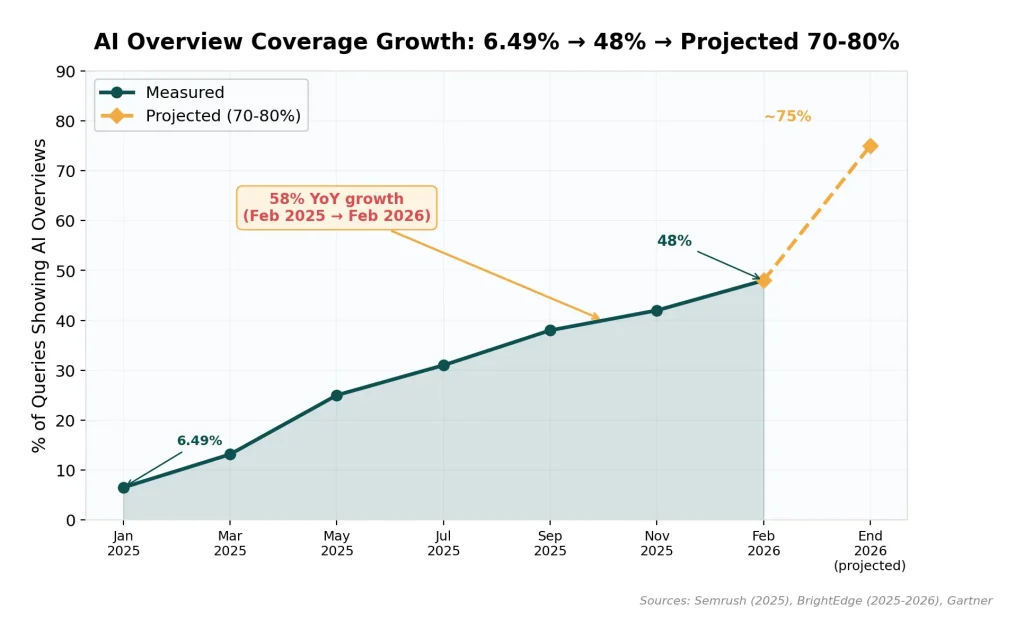
If current expansion rates continue, AI Overviews will appear on 70–80% of Google search queries by end of 2026. The trajectory from 6.49% in January 2025 to roughly 48% by February 2026 (BrightEdge, 2026) mirrors how mobile search once grew: quietly at first, then suddenly unavoidable.
Gartner’s projection that traditional organic search traffic will decline by 25% by 2026 has already gained credibility as AI Overview rollout has accelerated (Gartner). Their longer-range forecast – a 50% reduction in traditional organic traffic by 2028 – looks increasingly conservative as AI Mode (which shows a 93% zero-click rate vs. AI Overviews’ 43%) expands to more markets and becomes the default experience. While total search volume remains stable, the distribution of clicks has shifted significantly; the organic traffic crisis 2026 update benchmarks these losses across specific B2B verticals to isolate which content types still retain visibility.
Semrush projects that AI channels will drive equal economic value to traditional search by late 2027 (Semrush). This doesn’t mean equal traffic – it means the higher conversion premium of AI-referred visitors compensates for lower volume. The companies that build citation tracking infrastructure in 2026 will be measuring this value shift in real time. Those that don’t will be measuring the wrong things while their pipeline silently shifts to competitors who show up in the AI answer.
The citation landscape will consolidate. Early data suggests a winner-takes-most dynamic: as AI models improve their source selection, the gap between cited and uncited brands will widen. Those who invest now compound their advantage quarter over quarter. Those who wait face an increasingly steep climb against entrenched citation incumbents.
Conclusions
Key findings:
- SERP position #1 = 33.07% AI citation probability; #10 = 13.04% – a 60% decline
- AI visitors convert 23x better than traditional organic visitors (Ahrefs) / 4.4x (Semrush)
- Cited brands earn 35% more organic CTR and 91% more paid CTR vs. uncited brands (Seer Interactive)
- Content freshness is non-negotiable: 65% of AI bot hits target content < 1 year old
- The counter-narrative is real: AI Overview citations perform at Position 6 click levels – visibility ≠ traffic
The data is unambiguous: SERP position still determines AI citation probability, but the relationship is non-linear, industry-dependent, and requires entirely new attribution models to translate into revenue. Position #1 matters more than ever – not because of the blue link clicks it generates, but because it’s the foundation for the AI citation that carries a 23x conversion premium.
The companies that will win are those that treat citation tracking as core marketing infrastructure, not a side project. Citation Rate, Share of Voice, and Revenue Visibility Gap belong alongside pipeline metrics in every quarterly business review. The cost of ignoring this shift isn’t visible in traditional dashboards – it shows up as deals you never knew existed going to competitors you never saw coming.
The companies that build citation tracking infrastructure in 2026 will have compounding data advantages. The companies that wait will be measuring the wrong things while their pipeline silently shifts to competitors who show up in the AI answer. That is the fundamental revenue equation of AI search.
Want us to calculate your Revenue Visibility Gap and build the citation strategy to close it? [Book a consultation with The Digital Bloom →]
FAQ
What SERP position do I need to get cited in AI Overviews?
Position #1 gives you a 33.07% citation probability, the highest of any organic rank (GetPassionFruit, 2025). Being anywhere in the top 10 gives you a 76.1% chance that at least one page from that tier will be cited. However, positions beyond #10 see citation probability drop by approximately 4x, making top-10 ranking a practical prerequisite for AI Overview visibility.
How much revenue am I losing by not being cited in AI Overviews?
Use the Revenue Visibility Gap formula: (Uncited top-10 keywords) × (Estimated citation CTR) × (4.4x conversion multiplier) × (Average deal value). For a B2B company with 30 uncited keywords and a $25,000 ACV, the estimated annual revenue at risk exceeds $165,000. The exact figure depends on your industry, keyword volume, and conversion infrastructure.
How do I track AI citation impact in GA4?
Set up custom channel groupings in GA4 to separate AI-referred traffic. Use regex patterns to identify referral sources including ChatGPT (chatgpt.com, chat.openai.com), Perplexity (perplexity.ai), Google AI referrals, and Gemini. Track conversion events separately for this channel to measure the 23x conversion premium documented by Ahrefs against your own baseline.
Which industries are most affected by AI citation changes?
Healthcare (43.0% of all queries), Science (43.6%), and B2B Technology face the highest AI Overview exposure (Ahrefs, November 2025). On informational keyword sets specifically, BrightEdge data shows these verticals reach even higher penetration. Finance shows the highest citation volatility. eCommerce currently has the lowest exposure at 3.2% AIO trigger rate (Ahrefs, November 2025), but expansion into commercial queries is accelerating.
How often should I update content to maintain citation freshness?
Seer Interactive’s data shows 65% of AI bot hits target content published in the past year (Seer Interactive, October 2025). For fast-changing verticals like Financial Services, monthly updates to key pages are recommended. For evergreen verticals like Energy, quarterly refreshes maintain citation eligibility. As a baseline, no page targeting an AIO-eligible keyword should go more than 6 months without a substantive update.
Does AI citation optimization replace traditional SEO?
No. 76.1% of AI Overview citations come from pages already ranking in Google’s top 10 (Ahrefs, 2025). Traditional SEO builds the ranking authority that AI models use as a quality signal. Citation optimization is a layer on top – it ensures that your ranking authority translates into AI visibility. Without strong SERP foundations, AI optimization has nothing to build on.
References
Citation & Position Data Studies
- GetPassionFruit – “Why AI Citations Come from Top 10 Rankings: SERP Data Analysis” (2025) – https://www.getpassionfruit.com/blog/why-ai-citations-lean-on-the-top-10
- Seer Interactive – “AIO Impact on Google CTR: September 2025 Update” – 3,119 queries, 42 organizations, 25.1M impressions – https://www.seerinteractive.com/insights/aio-impact-on-google-ctr-september-2025-update
- Search Engine Land – “AI Overview Citations: Why They Don’t Drive Clicks” (September 2025) – 200+ SERPs analyzed – https://searchengineland.com/ai-overview-citations-clicks-what-to-do-462389
- Ahrefs – “Insights From 55.8M AI Overviews Across 590M Searches” (November 2025) – https://ahrefs.com/blog/ai-seo-statistics/
- SE Ranking – AI Mode and AI Overview overlap study (August 2025) – 10.7% URL overlap, 16% domain overlap
- BrightEdge – Generative Parser™ year-long AI Overview tracking (2025–2026) – https://www.brightedge.com/ai-overviews
- Amsive – 700,000-keyword CTR study (2025) – 15.49% average CTR decline, -37.04% with featured snippet overlap
Revenue & Conversion Research
- Ahrefs – “Does AI Search Traffic Convert Better Than Traditional Search?” (June 2025) – 23x conversion rate, 12.1% signups from 0.5% traffic – https://ahrefs.com/blog/ai-search-traffic-conversions-ahrefs/
- Semrush – AI search visitor value study (June 2025) – 4.4x visitor value
- Ahrefs – AI traffic quality study: visitors view 50% more pages per session (August 2025) – https://ahrefs.com/blog/ai-traffic-quality-study/
- Digiday / Microsoft Clarity – LLM conversion rates: 1.66% vs. 0.15% traditional (2025)
- SuperPrompt – AI traffic conversion study: 14.2% vs. Google’s 2.8% (2025)
Content Freshness & Industry Benchmarks
- Seer Interactive – “Study: AI Brand Visibility and Content Recency” (October 2025) – 5,000+ URLs, freshness patterns across verticals – https://www.seerinteractive.com/insights/study-ai-brand-visibility-and-content-recency
- BrightEdge – AI Overview industry penetration data (Healthcare, Education, B2B Tech, Insurance near 90%) (2025)
- BrightEdge – Year-over-year AI Overview growth: 31% to 48% of queries, 58% increase (February 2026)
- BrightEdge – March 2025 core update: Entertainment +528%, Restaurants +387%, Travel +381%
- Surfer SEO – Core sources cover 42% of key facts for their topic; AIO-cited articles cover 62% more facts (November 2025)
- Ahrefs – 17 million citation freshness analysis; AI-cited content 25.7% fresher than traditional organic (2025)
Platform & Market Analysis
- Ahrefs – AI Overview and AI Mode: 13.7% URL overlap (December 2025)
- Ahrefs – ChatGPT: 6.82% overlap with Google’s top 10; 28.3% of most-cited pages have zero Google visibility (2025)
- SE Ranking – AI Mode: 93% zero-click rate; 9.2% self-overlap on repeated tests (August 2025)
- Gartner – 25% search volume decline by 2026; 50% organic traffic reduction by 2028
- Semrush – AI channels projected to drive equal economic value to traditional search by late 2027
- SparkToro – Less than 1 in 100 chance of consistent brand recommendations across prompts
- BrightEdge – “How AI Engines Choose Brands: Citation Patterns Revealed” (2025) – https://www.brightedge.com/resources/weekly-ai-search-insights/how-different-ai-search-engines-choose-which-brands-to-recommend
- BrightEdge – AI brand sentiment study: Google AIO 44% more likely to criticize brands than ChatGPT (March 2026) – https://www.globenewswire.com/news-release/2026/03/05/3250207/0/en/
- Ahrefs Evolve 2025 – Branded web mentions as #1 predictor of AIO citation (0.664 correlation) (October 2025)
- Position Digital – 90+ AI SEO Statistics compilation (updated March 2026) – https://www.position.digital/blog/ai-seo-statistics/