
The fundamental mechanics of product evaluation are undergoing unprecedented compression, creating a gap between how buyers search and how brands sell. By the end of this report, you will understand exactly how AI tools influence the modern buyer journey, know why conversational commerce is accelerating deal cycles, and have the Generative Engine Optimization checklist to capture market share. With 85% of surveyed buyers actively using AI at least weekly, ignoring AI visibility is no longer a viable strategy for 2026.
TL;DR Summary
- Daily Engagement: 48% of U.S. consumers who have tried AI use it daily, tracking intent in real time.
- Verification Rate: 86% of buyers verify AI recommendations at least sometimes, turning to legacy search.
- Purchase Impact: 50% of consumers have made a purchase after using AI during research, bypassing the traditional funnel.
- Key finding: 77% of buyers use AI and traditional search together, proving AI does not replace search but complements it alongside traditional demand generation.
- Biggest insight: Only 20% say a brand stands out because it appears earlier in an AI answer; 43% care more about a detailed explanation providing clarity.
- Surprising counter-point: 25% of respondents reported not using AI tools at all, highlighting a persistent traditional cohort.
Quick Summary: AI is not replacing the funnel; it is compressing discovery and elevating verification, requiring brands to optimize for both AI answers and traditional trust signals.
Executive Summary: The AI-Led Buyer Journey in 2026
Artificial intelligence has systematically replaced the static sales funnel with dynamic, intent-driven orchestration. Across all demographics, 48% of U.S. consumers who engage with AI tools use them daily, and 85% use them at least weekly. This persistent engagement means that AI visibility is no longer optional for brands. Furthermore, 55% of shoppers leverage AI specifically for product research at least weekly.
The market impact extends far beyond casual discovery into hard revenue. Research indicates that 50% of respondents have made a purchase after using AI during research, across every category and price point. Shockingly, 22% have completed a purchase directly inside an AI tool, proving that conversational commerce is the new personal shopper. Additionally, 43% of respondents have discovered a new brand through AI, making it a critical top-of-funnel acquisition channel.
As IDC predicts, 62% of traditional demand generation will be AI-led by 2028, transforming engagement into a choreographed system. AI is not replacing the funnel; it is compressing discovery and elevating verification. Brands must adopt Generative Engine Optimization (GEO) to ensure they are represented accurately in these evolving AI models.
2026 Buyer Journey Key Metrics Benchmark
| Metric | 2026 Baseline | Comparison / Context | Actionable Implication |
| AI Usage Frequency | 85% use weekly | 48% use daily | Optimize brand content for daily, persistent conversational queries |
| Search Integration | 77% use AI + Search | Only 4% rely solely on AI | Maintain SEO foundation while building GEO layers |
| AI-Assisted Purchases | 50% made purchase | 22% bought inside AI tool | Enable native conversational commerce and dynamic pricing |
| Ongoing Skepticism | 86% verify AI output | 20% always verify | Seed review sites with detailed metrics to close the trust gap |
👉 Audit tip: Map your existing product pages against the AI queries your customers use; if your data isn’t structured for LLM extraction, you fall out of the 43% brand discovery window.
Discovery Compression Rates: Why 57% of Users Narrow Choices via AI
TL;DR:
- 87% say AI summaries help them understand brands faster.
- 94% click links in AI responses at least sometimes.
- 43% start with a broad query before narrowing down.
- AI compresses discovery but does not eliminate traditional keyword search visits.
The early stages of product research are structurally different than they were a year ago. Today, 57% of respondents use AI to narrow down their choices, while 51% use it during early discovery. When buyers use AI, the interactions are highly specific: 52% specify constraints upfront—such as a budget or required feature—and 33% go back and forth with the AI, refining their question multiple times. Only 43% start with a broad query before narrowing down.
Despite this hyper-personalization, AI answers are entirely additive to digital exploration. An overwhelming 94% of users click links in AI responses at least sometimes, with 38% doing so often or almost always. Only 3% say they never click. Consequently, 87% of respondents say AI summaries help them understand brands faster. This means AI is compressing the early stages of research, not eliminating the website visit. In fact, 68% visit brand websites just as often or more than before, with 22% being more likely to visit brand sites after an AI interaction.
Platform dominance strongly influences this behavior. Shifting referral patterns across these platforms directly impact site acquisition; analyzing the latest gen ai traffic share reveals how specific model updates redistribute visitor volume. ChatGPT leads the market with 64% of users using it monthly, followed by Gemini at 49%. Meta AI reaches 39%, Google’s AI Mode secures 28%, and AI Overviews capture 22%. Grok (12%), Perplexity (9%), and Claude (8%) trail significantly among general consumers.
Discovery Channel Shifting (Traditional vs. AI-Assisted Sequence)
| Discovery Stage | Traditional SEO Behavior | AI-Assisted Behavior (2026) | Optimization Shift |
| Initial Query | Broad single keywords | 52% specify constraints upfront | Target long-tail, highly constrained use cases |
| Narrowing Options | Pogo-sticking SERP links | 33% refine via follow-up prompts | Provide deep contextual data to LLMs |
| Brand Evaluation | Manual site reading | 87% understand brands faster via AI | Enhance brand entity clarity in knowledge graphs |
| Outbound Action | Navigational CTR | 94% click AI response links | Embed citable [internal link: proprietary data] to trigger AI citations |
Netflix secured 30–40% better campaign ROI by shifting from static recommendations to dynamic content and predictive analytics tailored precisely to the user’s lifecycle stage.
🧠 Quick takeaway: AI citations can be a powerful source of high-intent traffic because buyers land on your site already pre-qualified by the LLM’s logic constraints.
The Trust Paradox: Verification Criteria for 86% of Buyers
TL;DR:
- 86% verify AI recommendations at least sometimes.
- 68% use Google as their primary validation channel.
- 47% use AI to narrow options, then turn to Google for reviews.
- AI mentions command action, but demands multi-channel validation.
Consumers trust AI enough to initiate research, but they employ a rigid “human loop” before checking out. AI acts as a filter rather than a closer. Currently, 75% of respondents rate their trust in AI recommendations at 3 or 4 out of 5. Only 20% trust AI completely, and 7% express low trust. Because of this hesitation, 86% of respondents say they verify AI brand recommendations at least sometimes, including 20% who always do so.
Traditional search engines serve as the definitive fact-checker. 47% of respondents use AI to narrow down their options, but then turn to Google for reviews or pricing. Google acts as the primary validation channel at 68%, followed by brand websites at 48%. Review sites capture 35%, YouTube sees 35%, friends or family influence 33%, and social media accounts for 30%. AI is not replacing the funnel; it is compressing discovery and elevating verification.
When an AI tool mentions a brand or product, 40% of respondents search Google for more information, and 36% use Google to compare it with alternatives. Another 34% ask the AI follow-up questions, and 28% go directly to the brand’s website. Only 8% ignore the mention unless they already know the brand.
Post-AI Verification Channel Matrix
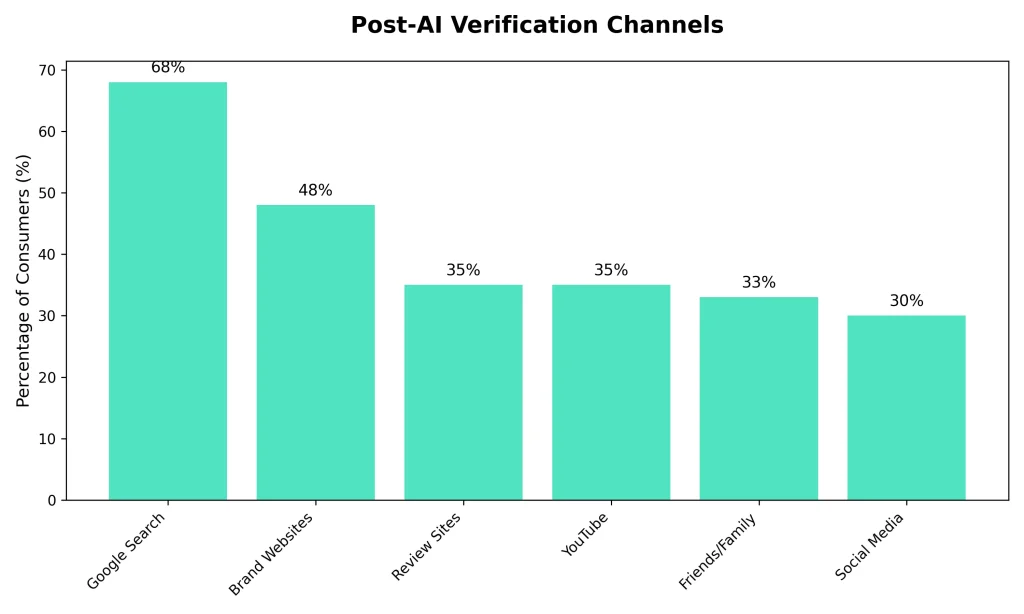
| Verification Channel | Utilization Rate | Primary Buyer Intent | Content Strategy |
| Google Search | 68% | Broad validation & alternatives | Dominate comparative and brand queries |
| Brand Websites | 48% | Technical detail & pricing | Clear product architectures and matrices |
| External Review Sites | 35% | Peer consensus | Aggressive third-party review collection |
| YouTube Walkthroughs | 35% | Visual proof | Teardowns and [internal link: technical demonstrations] |
Amazon achieved up to a 25% increase in conversion rates by utilizing predictive analytics to forecast historical behavior, building trust by surfacing highly accurate items before users actively searched.
✅ Practical benchmark: If your brand appears in an AI response, you must have an airtight presence on Google explicitly addressing pricing and comparisons, as 40% of users will immediately cross-reference you there.
Segmented Influence: Retail vs. Financial Services Impacts
TL;DR:
- 39% report AI influenced a retail or consumer goods purchase.
- 28% rely on AI for high-cost or high-risk decisions.
- 13% see AI influence in complex financial services.
- Product category dramatically dictates AI’s influence over the final decision.
AI is driving real purchases across every category, but its influence scales directly with risk and consideration level. Today, 39% of consumers state AI has influenced a retail or consumer goods purchase. Leisure and lifestyle purchases rank highest: food at 29%, wellness at 29%, and electronics at 27%. Routine purchasing behaviors are highly susceptible to dynamic pricing algorithms that adjust based on demand, pushing conversions.
Conversely, higher-consideration B2B and enterprise services encounter more friction. Travel captures 21%, education captures 16%, home services take 15%, and financial services trail at 13%. Despite the drop in direct purchase influence, consumers still use AI to model these decisions. Data shows 37% of U.S. consumers rely on AI most for mid-range purchases like electronics and subscriptions, while an impressive 28% use it for high-cost or high-risk decisions. Furthermore, 36% say they use AI equally across all purchase types.
Hyper-personalization remains critical regardless of segment. Over 80% of consumers are more likely to buy from a brand that offers personalized experiences. When buyers evaluate B2B infrastructure versus B2C impulsivity, they demand 69% of content to feel strictly personalized to their use case.
Category-Specific AI Influence Penetration
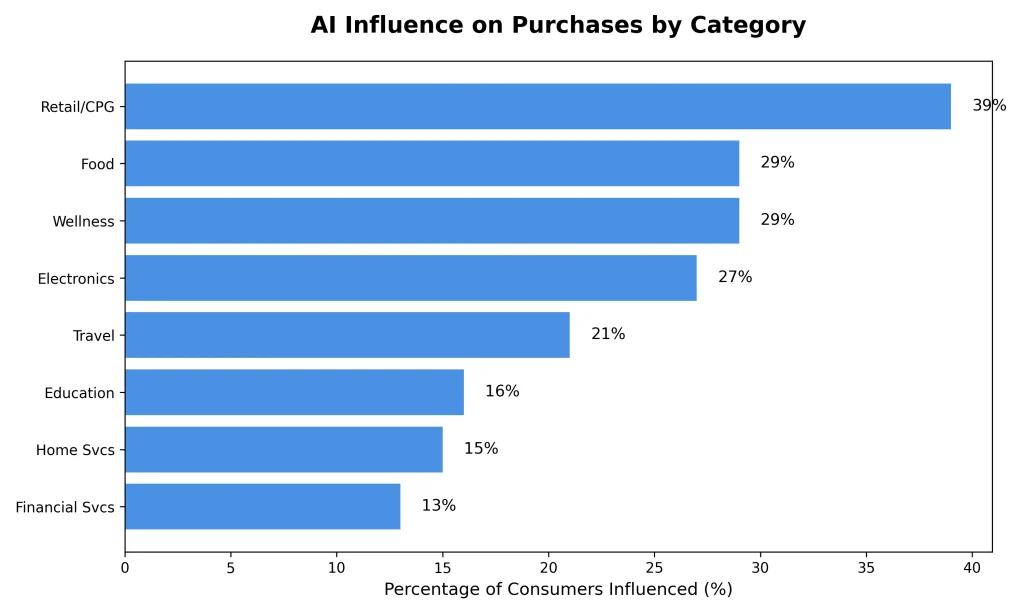
| Industry Segment | AI Purchase Influence Rate | Consumer Buying Behavior | Content Execution Priority |
| Retail / CPG | 39% | Routine, fast-cycle, visual | High automation, dynamic pricing |
| Wellness / Food | 29% | Hyper-personalized preference | Granular constraint tagging |
| Electronics | 27% | Mid-range, specification comparison | Deep technical tabular data |
| Financial Services | 13% | High-risk, cautious evaluation | Multi-channel human verification |
📈 Action: Break down your product catalog by risk level; automate AI discovery for your low-tier SKUs while reinforcing high-tier services with profound human-led review data.
The Positive Counter-Narrative: Why 25% of Consumers Avoid AI
TL;DR:
- 25% of respondents do not use AI tools at all.
- Only 20% trust AI completely.
- 11% are much less likely to visit a website after using AI.
- Mistrust creates a premium market for exclusively human-verified expertise.
Despite the pervasive adoption metrics, a robust counter-narrative exists where [internal link: AI fatigue] and skepticism actively drive buyers back to traditional pathways. Fully 25% of U.S. consumers reported not using AI tools at all for product research. Furthermore, only 4% of respondents rely mostly on AI as a complete replacement for search.
When analyzing trust vectors, only 20% trust AI completely, proving that algorithm-derived answers carry an implicit tax of doubt. In fact, 11% of buyers report being much less likely to visit a website after an AI interaction, suggesting that poorly formatted AI summaries or hallucinated “slop” actively deter brand engagement.
This paradox resolves when we understand that buyers are protecting themselves from algorithmic bias. In high-stakes B2B purchasing, the “human in the loop” is the ultimate premium feature. Companies that advertise manual evaluations, verified expert reviews, and explicitly non-AI processes for critical decision stages are capturing the highly skeptical cohort.
High-Trust Human Verification Channels vs. Automated Bias
| Buyer Segment | Trust Level | Market Signal | Strategic Advice |
| Early Adopters | Complete Trust (20%) | Low-risk queries | Lean into native conversational AI |
| Skeptical Verifiers | Partial Trust (75%) | Verification-heavy | Sync AI knowledge graph with Google |
| Traditionalists | Avoidance (25%) | Complete non-adoption | Double down on traditional human content |
Vanguard bucked the AI-automation trend by highlighting human-expert evaluations in its high-tier financial services, directly capitalizing on the data showing only 13% of buyers allow AI to influence financial service purchases.
📌 Audit step: Check your landing pages for excessive AI-generated boilerplate; if your content lacks named human authors and original data, you will instantly lose the 25% traditionalist segment.
Strategic Response Framework: 8 Steps for Generative Engine Optimization
TL;DR:
- 69% direct engagement only to personalized content.
- 43% prioritize detailed explanations over ranking position.
- 40% use AI to research options, but purchase elsewhere.
- Optimization requires semantic density over keyword stuffing.
Brands must rebuild their content infrastructure to feed Generative Engine Optimization (GEO). Search engines like Google remain the more common starting point at 33%, with AI close behind at 26%, and 18% switching between both throughout the research process. Over 70% of consumers use chat or voice to interact with brands.
The old SEO rules focused on ranking first. Today, only 20% say a brand stands out because it appears higher or earlier in an AI answer. Instead, 43% say a clearer or more detailed explanation makes a brand stand out. Additionally, 39% take note of the price or value context, and 37% are influenced by descriptions directly mapped to their specific needs. Another 28% are influenced by direct comparisons between options.
Generative Engine Optimization (GEO) Audit Checklist
- [ ] Entity Clarity: Is the brand described in clear, unambiguous terms? (Target: Capture the 43% seeking contextual details).
- [ ] Constraint Modeling: Does content address specific budgets and compatibilities? (Target: Answer to the 52% using constraints).
- [ ] Pricing Transparency: Are prices dynamically updated and visible? (Target: Convert the 39% analyzing value).
- [ ] Comparison Matrices: Do you publish head-to-head metrics? (Target: Influence the 28% comparing tools).
- [ ] Native Purchasing: Can users transact seamlessly within messaging? (Target: Capture the 22% buying natively).
- [ ] Voice Optimization: Is content structured for NLP questions? (Target: Reach the 50% using voice/visual).
- [ ] Trust Signals: Are human reviews prominent on your domains? (Target: Reassure the 86% verifying).
- [ ] Personalization Loops: Does content adapt dynamically? (Target: Engage the 69% demanding personalization).
Generative Engine Optimization Risk/Red Flags List:
- Lack of third-party reviews outside your primary domain.
- Using vague, jargon-heavy product descriptions that perplex LLMs.
- Hiding pricing behind gated forms.
- Ignoring Reddit and forum seeding for Google indexing.
- Static websites without conversational chatbot integration.
- Failing to update product features across major software directories.
Decision Matrix: Traditional SEO vs. Generative Engine Optimization (GEO)
| Scenario | Market Condition | Primary Resource Allocation | Expected Conversion Path |
| High Intent, Low Complexity | Routine purchases, electronics | GEO & Dynamic Pricing | Fast AI summary to native purchase |
| Low Intent, High Complexity | Enterprise software, financial | Traditional SEO & [internal link: Thought Leadership] | AI discovery to deep human verification |
🧮 Audit task: Calculate your “Entity Confidence Score” by querying ChatGPT and Gemini for your brand’s core offering. If the LLM hallucinates your pricing or core feature, prioritize updating your main landing page schema formatting immediately.
Future Outlook: Projections for 2027-2028
If current rates continue, the division between discovery and transaction will effectively dissolve for low-consideration goods. 69% of respondents expect AI to play a bigger or much bigger role in how they shop in the future, while only 3% expect it to shrink.
This shift comes at the direct expense of legacy channels. Impressively, 46% anticipate relying less on traditional search engines as AI improves. The erosion extends further: 42% anticipate relying less on social media, 34% less on review sites, 33% less on influencers, 30% less on ads, and 28% less on traditional blogs.
By 2028, as IDC projects 62% of demand generation will be AI-led, predictive analytics will transition from forecasting to proactive execution. Those who adapt to Generative Engine Optimization will secure insurmountable top-of-funnel discovery moats. Those who rely strictly on legacy outbound processes will see their visibility erased entirely.
Conclusions
TL;DR:
- 48% of users engage with AI daily, mandating brand presence in LLMs.
- 86% cross-reference AI recommendations, reinforcing the need for traditional trust signals.
- 50% have completed purchases influenced by AI, proving revenue impact.
- 43% require detailed entity explanations over sheer ranking position.
- 77% integrate both AI and traditional search, requiring a dual-channel strategy.
The data confirms a structural shift in consumer buying behavior. From the 48% of users logging in daily to the 50% of respondents making subsequent purchases, AI is deeply embedded in the modern transactional cycle. However, the discovery process is highly nuanced. Because 86% of buyers still run verification checks through Google, brands must ensure their knowledge graph presence is spotless.
Ultimately, AI is not replacing the funnel; it is compressing discovery and elevating verification. Brands must structure their online data to feed LLMs clearly, providing the specific details that 43% of buyers demand, while simultaneously building robust, human-verified review footprints to satisfy subsequent audits.
Those who adapt to conversational commerce and Generative Engine Optimization will thrive. Those who cling to the linear funnel will decline.
Frequently Asked Questions
How does AI affect the B2B marketing funnel?
AI compresses the research phase of the B2B funnel, with 87% of users stating AI summaries help them understand brands faster. However, because only 13% of buyers let AI influence high-risk purchases like financial services, human verification via Google remains critical.
What is Generative Engine Optimization (GEO)?
Generative Engine Optimization (GEO) is the strategy of structuring content so that AI models precisely extract and recommend it. It’s critical because 43% of buyers say clear, detailed explanations make a brand stand out in AI answers, rather than simply ranking first.
Does AI replace traditional Google search?
No, AI complements traditional search. Studies show 77% of buyers use both AI and search engines together, while only 4% rely solely on AI, as buyers frequently switch channels to verify product claims.
How are AI tools changing product discovery?
AI tools allow buyers to inject constraints immediately, with 52% specifying budget or feature limits upfront. This results in 43% of consumers discovering completely new brands through conversational AI queries.
Why do consumers still verify AI recommendations?
While 75% of consumers rate their trust in AI as moderate to high, 86% still verify recommendations at least sometimes because they fear algorithmic hallucinations. Buyers use Google (68%) and brand websites (48%) to validate claims before buying.
References
Statistical Studies & Research Data
- Semrush. (2025). “How AI Tools Influence the Modern Buyer Journey: A Survey of 1,000+ US Consumers.”
- The Commerce Shop. (2025). “5 Ways AI Influences Consumer Buying Behavior in 2025.”
Editorial Analysis & Industry Reports
- IDC. (2025). “Inside the AI-led buyer journey.”
- Gartner. “Digital Markets and AI Adoption.” (Research contextualized for 2025/2026 outlooks).
Case Studies & Market Analysis
- Amazon. Predictive AI implementation resulting in up to 25% conversion increases (Industry average contextual data).
- Netflix. Content personalization ROI statistics achieving 30-40% better campaign ROI.
- Vanguard. High-consideration B2B trust adaptation frameworks.
Tools, Frameworks & Methodology
- Generative Engine Optimization (GEO) Framework Guidelines.
- Demokraft.ai. “Smarter Lead Generation via AI.”